
Interviewers don’t just want to know if you can write code; they want to know if you can build the right software, the right way, as part of a team. Your grasp of the SDLC demonstrates your professionalism, foresight, and ability to contribute to a project’s success from conception to retirement.
This guide will walk you through the common SDLC interview questions, how to answer them, and how to structure your preparation.
Part 1: The Fundamentals – Know Your Models
You will almost certainly be asked to explain different SDLC models. Don’t just recite definitions; show you understand the why.
Common Models to Master:
Waterfall: A linear, sequential approach.
-
-
When to use it? Projects with clear, fixed requirements (e.g., government contracts, medical device software). It’s predictable but inflexible.
-
Interview Tip: Be ready to discuss its disadvantages (e.g., late testing, difficulty accommodating changes) and why the industry has largely moved away from it for most projects.
-
Agile: An iterative, incremental, and flexible approach. This is the gold standard today.
-
-
Key Concepts: Sprints, User Stories, Daily Stand-ups, Continuous Integration/Continuous Deployment (CI/CD).
-
Interview Tip: Be prepared to talk about your experience with specific Agile frameworks like Scrum or Kanban. Mention tools like Jira, Trello, or Azure DevOps.
-
Iterative & Incremental: Develops a system through repeated cycles (iterative) and in smaller portions (incremental).
-
-
Interview Tip: Highlight how this model allows for early feedback and reduces project risk compared to Waterfall.
-
DevOps: Not just a model, but a culture and practice that extends Agile by bridging the gap between Development and Operations.
-
-
Key Concepts: Automation, CI/CD pipelines, Infrastructure as Code (IaC), monitoring.
-
Interview Tip: If you have experience with tools like Jenkins, Docker, Kubernetes, or AWS/Azure, this is your time to shine!
-
Sample Question: “Can you compare and contrast the Waterfall and Agile models?”
Strong Answer Framework:
“Waterfall is a linear, phase-gated model where each phase must be fully completed before the next begins. It works well for projects with very stable, well-understood requirements. However, its main drawback is the lack of flexibility; making a change late in the cycle is very costly.
Agile, on the other hand, is iterative and collaborative. We deliver working software in short cycles called sprints, which allows us to gather user feedback early and adapt to changing requirements. While Agile requires a high level of customer collaboration and can be less predictable in terms of a final delivery date, it significantly reduces the risk of building the wrong product. In my previous role, we used Scrum, and our two-week sprints allowed us to pivot quickly when stakeholder priorities shifted.”
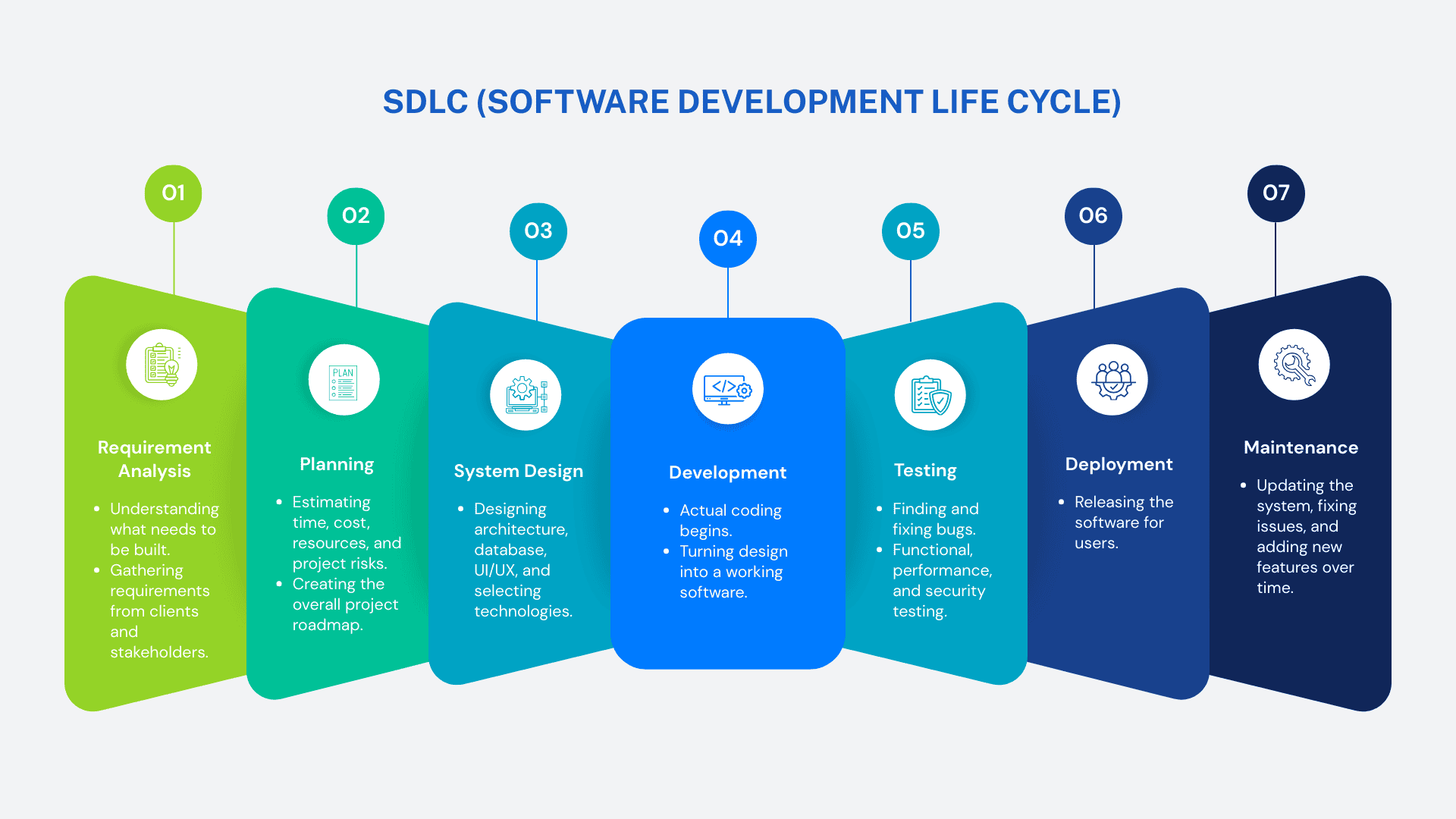
Part 2: Beyond the Models – The Core Phases & Concepts
Interviewers will probe your knowledge of the individual phases and how they interconnect.
Key Areas for Questions:
-
Requirements Gathering: How do you ensure requirements are clear, testable, and complete? What is the difference between functional and non-functional requirements?
-
Design (High-Level & Low-Level): What is system architecture? Have you worked with UML diagrams? What is the importance of a tech stack decision?
-
Development/Coding: This is where your technical skills are tested. Be ready for coding challenges, but also be prepared to discuss code quality, standards, version control (Git), and peer reviews.
-
Testing: Know the different levels of testing:
-
Unit Testing: (Developer) Testing individual components.
-
Integration Testing: Testing how modules work together.
-
System Testing: (QA) Testing the complete system against requirements.
-
UAT (User Acceptance Testing): The end-user validates the software.
-
-
Deployment: What is the difference between a blue-green deployment and a canary release? What is a rollback strategy?
-
Maintenance: What is the difference between corrective, adaptive, and perfective maintenance?
Sample Question: “A critical bug is found in production. What is your process?”
Strong Answer Framework:
“My first step is to prioritize and triage the bug to understand its severity and impact. I would then work to replicate the issue in a staging environment. Once replicated, I would identify the root cause, develop a fix, and write a unit test to prevent regression. This fix would go through our standard peer review and CI pipeline. For a critical bug, we might fast-track this process. After deployment, I’d document the incident and the root cause analysis to help prevent similar issues in the future.”
Part 3: The Behavioral & Situational Questions
This is where you prove you can apply your knowledge. Use the STAR method (Situation, Task, Action, Result) to structure your answers.
Common Themes:
-
Handling Changing Requirements: “Tell me about a time when requirements changed mid-sprint. What did you do?”
-
Dealing with Tight Deadlines: “How do you ensure quality when under pressure to deliver?”
-
Team Conflict: “Describe a disagreement you had with a teammate or manager about a technical or design decision. How was it resolved?”
-
Process Improvement: “Have you ever suggested a change to your team’s development process? What was the outcome?”
Sample Question: “Describe a project that failed or had major issues. What did you learn?”
Strong Answer Framework (using STAR):
(Situation) “In a previous project, we were building a new feature using a strict Waterfall approach. (Task) My task was to develop the backend service based on the initial specification document. (Action) Midway through development, the product team provided crucial feedback that fundamentally changed the data model. Because we were in the Waterfall model, this created massive rework and delays. We had to go back to the design phase. (Result) The project was delivered late and over budget. The key lesson learned was the critical importance of iterative feedback. This experience is why I’m such a strong advocate for Agile methodologies, as they build feedback loops directly into the process.”
Part 4: Your Interview Preparation Checklist
Review the SDLC Models: Be able to draw and explain at least 3 models (Agile, Waterfall, DevOps are key).
Deep Dive into Your Role’s Phase: If you’re a developer, be an expert on coding standards and version control. If you’re in QA, be ready to explain your test strategy for a given feature.
Prepare Your Stories: Brainstorm 3-5 real-world project stories that demonstrate your experience with the SDLC, teamwork, problem-solving, and handling adversity.
Research the Company: What is their likely development process? Check their job descriptions and tech blog for clues (e.g., do they mention “Scrum,” “Kanban,” “CI/CD”?).
Prepare Your Own Questions: This shows genuine interest. Ask:
“Can you describe your team’s development process?”
“How do you balance technical debt with feature development?”
“What is your release cycle like?”
Final Thought
An SDLC interview isn’t a memory test. It’s a conversation to see if you are a thoughtful, process-aware engineer who can navigate the complexities of real-world software development. By combining solid theoretical knowledge with concrete examples from your experience, you’ll demonstrate that you’re not just a coder, but a valuable member of any software team.
Good luck, and go ace that interview!